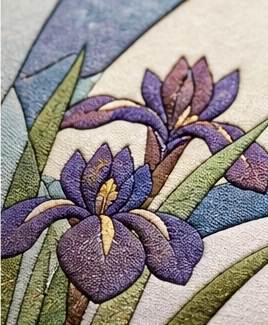

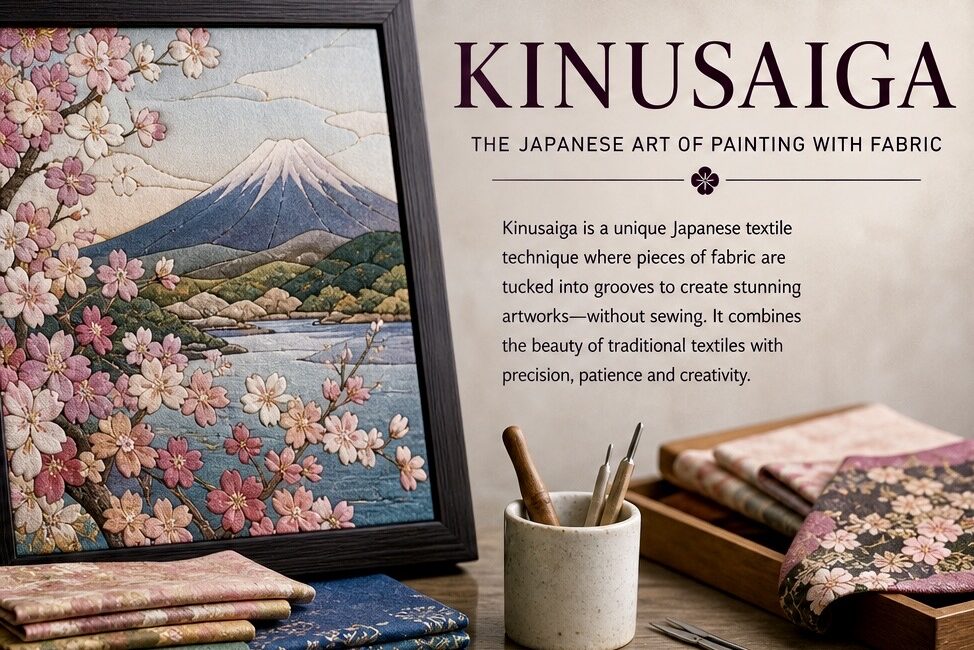
Kinusaiga is a distinctive Japanese textile art that
transforms fragments of fabric into intricately composed
images, without a single stitch. Often described as “painting
with cloth”, it occupies a compelling space between
traditional craft and contemporary decorative practice.
Defined by precision, restraint and a refined sensitivity to
colour and texture, kinusaiga invites both maker and viewer
into a slower, more attentive mode of seeing.
What Is Kinusaiga?
At its core, kinusaiga is a no-sew fabric inlay technique.
Rather than stitching pieces together, the artist works on a
firm base historically wood, though now more commonly
polystyrene or foam into which a design has been incised.
Fabric is cut into small, carefully shaped pieces and laid
over the design. The edges are then gently pressed into the
fine grooves carved into the surface. This process secures
the textile while producing crisp outlines and a subtle relief.
The finished work can resemble a painting, a mosaic, or
even stained glass, depending on the interplay of colour,
pattern and composition.
Origins and Development
Kinusaiga is a relatively recent addition to the history of
Japanese craft, generally understood to have emerged in the
late twentieth century, most likely during the 1980s. Unlike
many established Japanese art forms, it does not have a
clearly documented founder, nor a single point of origin
firmly recorded in academic literature.
It is better understood as an inventive adaptation of earlier
textile and decorative traditions. Its development reflects a
broader tendency within Japanese material culture: the
reimagining of inherited practices through contemporary
needs, tools and aesthetics. In this sense, kinusaiga is less
an isolated invention than a continuation of an evolving
craft ethos.
Cultural Context
Although modern in technique, kinusaiga resonates deeply
with long-standing Japanese cultural values. Central among
these is a respect for materials. Historically, textiles
particularly silk from kimono were precious and rarely
discarded. Instead, they were repurposed, layered with
memory and meaning.
Kinusaiga quietly extends this sensibility. The reuse of
fabric, especially from garments, introduces a narrative
dimension: each fragment carries traces of its previous life.
Alongside this, the discipline of the technique reflects a
broader cultural emphasis on precision, patience and
attentiveness.
Aesthetically, kinusaiga aligns with a preference for
balance, harmony and subtlety. Its beauty is rarely
ostentatious; it emerges through careful decisions of tone,
texture and placement rather than dramatic gestures.
Technique and Materials
Traditional Approach
Early kinusaiga works were typically made using wooden
boards as a base, combined with fine silk fabrics, often
repurposed from kimono. Artisans used hand tools to carve
delicate grooves, requiring considerable control and skill.
Contemporary Practice
Today, the method has become more accessible. Foam or
polystyrene boards are widely used, as they are easier to cut
and more forgiving for beginners. A broader range of
fabrics cotton, linen, synthetics and printed textiles has
expanded the visual possibilities. Craft knives and simple
blunt tools replace specialised carving instruments in many
cases.
Process Overview
The making process follows a clear sequence:
A design is drawn or transferred onto the base
Fine grooves are cut along the outlines
Fabrics are selected with attention to colour, pattern and
texture
Each piece is placed over its corresponding section
The edges are pressed into the grooves to secure the fabric
While technically straightforward, the process demands a
high level of judgement. The illusion of depth, light and
shadow depends entirely on the choice and placement of
fabric rather than the application of paint.
Visual Characteristics
Kinusaiga works are immediately recognisable through
several defining qualities:
Clean, precise lines formed by recessed edges
A rich surface created through layered textiles
Subtle tonal variation achieved through fabric selection
A low-relief effect that introduces a gentle three-
dimensionality
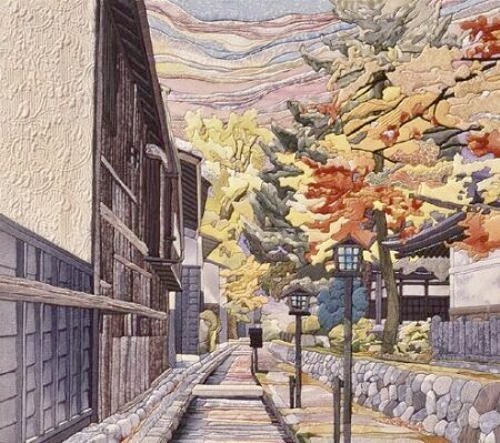
Common subjects include landscapes, seasonal imagery,
florals, animals, architectural scenes and decorative motifs.
The absence of stitching allows the surface to remain
smooth and uninterrupted, enhancing the impression of a
painted image while retaining a tactile presence.
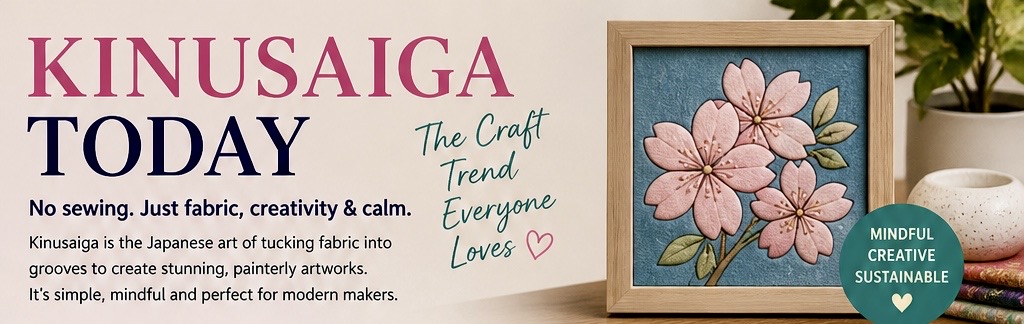
Kinusaiga in Contemporary Practice
Today, kinusaiga exists primarily within the realm of
decorative and craft arts rather than the international fine art
market. It is widely practised as a hobby, taught in
workshops and community settings, and frequently
available in kit form for beginners.
Part of its appeal lies in its accessibility. It offers a way into
textile art for those without sewing experience, while still
providing depth and complexity for more experienced
practitioners. Rather than being defined by a canon of
recognised artists, kinusaiga thrives through shared
knowledge, teaching and adaptation across communities.
Relationship to Textile Art
Kinusaiga sits within a broader field of textile-based visual
practices, including quilting, appliqué and fabric collage.
What distinguishes it is its structural logic: fabric is held in
place by tension within carved grooves, rather than by
stitching or adhesive.
This gives the technique a hybrid character. It borrows the
compositional language of painting, the material richness of
textile art, and the precision associated with carving or
engraving. The result is a form that resists easy
categorisation, occupying a unique position between
disciplines.
Global Reach
Since its emergence in the late twentieth century, kinusaiga
has spread beyond Japan, gaining popularity across Europe
and other regions. This expansion has been driven by craft
publications, online tutorials, and the availability of DIY
kits.
Its visual clarity and relatively approachable technique
make it particularly appealing within contemporary craft
culture, where there is growing interest in slow, mindful
and hands-on creative practices. Kinusaiga aligns naturally
with this movement, offering both structure and creative
freedom.
Kinusaiga demonstrates how a contemporary craft can
emerge from traditional sensibilities without being
constrained by them. Its origins may be loosely
documented, but its identity is distinct: a method of image-
making that replaces paint with fabric and stitches with
precision cutting.
Balancing accessibility with artistic potential, kinusaiga
continues to evolve as both a personal craft and a
decorative art form. In its quiet, methodical process, it
reveals how texture, colour and careful attention can
transform simple materials into intricate visual narratives.