
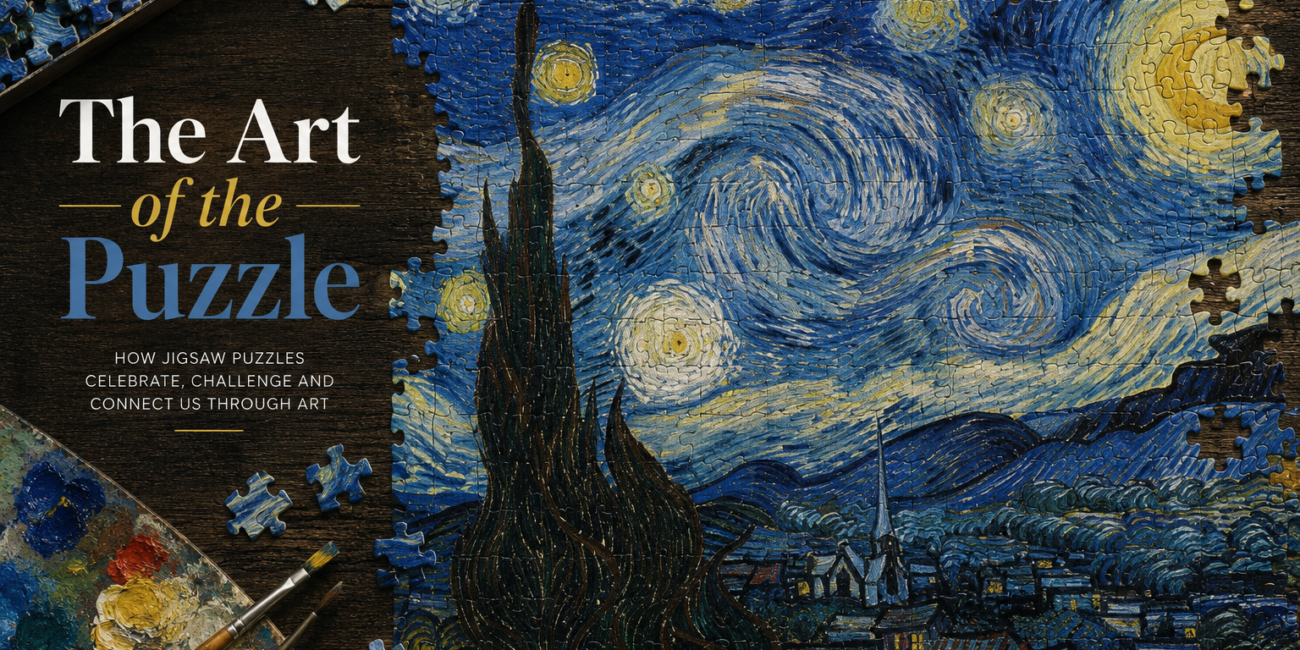
The modern gallery is no longer a silent room of white walls and hushed
whispers. It is a kitchen table, scattered with one thousand cardboard fragments.
For centuries, fine art demanded a respectful distance from its audience. Today,
a quiet revolution is rewriting that relationship. The jigsaw puzzle has evolved
from a simple rainy-day distraction into the ultimate slow art movement. By
forcing us to touch, examine, and reconstruct an image, puzzling bridges the
gap between passive viewing and active collaboration, fundamentally changing
how we experience visual culture.
Deconstructing the Puzzle
To understand the medium, one must first understand the anatomy of a puzzle.
A jigsaw puzzle is a tiling challenge requiring the assembly of numerous
interlocking, uniquely shaped fragments. When correctly fitted together, these
fragments produce a complete, cohesive picture. While modern iterations
predominantly use dense cardboard, premium collector variants employ fine
woods or cast acrylics. The structural layout typically relies on two core cutting
styles: the traditional ribbon cut, which forms a predictable grid, and the random
or whimsical cut, which uses highly irregular shapes. The puzzle pieces connect
using interlocking tabs and blanks, often referred to as knobs and sockets,
across dimensions that range from microscopic travel sets to giant exhibition
pieces containing over 40,000 fragments.
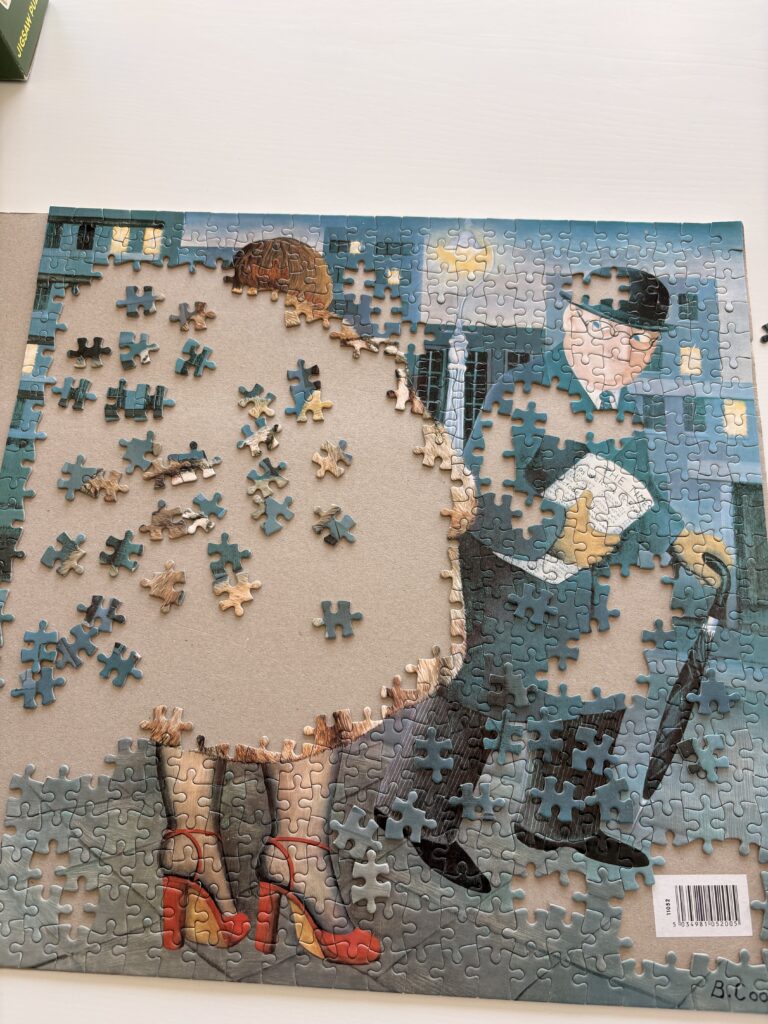
Cartography to Cardboard: The Origins
The medium began far from the leisure room, emerging in a definitive
chronological timeline. The very first variant appeared in the world in the 1760s,
specifically around 1766, when British cartographer and engraver John Spilsbury
invented wooden dissected maps. He mounted a map of Europe onto a thin
sheet of mahogany wood and used a hand-operated marquetry saw to carve
along national borders. These early creations served strictly as geography
teaching aids for affluent schoolchildren, including the offspring of King George
III.
The industry evolved rapidly over the next two centuries. By the 1880s, the
mechanical foot-powered scroll saw was invented, shifting the industry
terminology from dissected maps to jigsaw puzzles. In the early 1900s,
manufacturers introduced interlocking tabs and blanks to prevent pieces from
sliding apart. This paved the way for the 1930s, when the economic hardships of
the Great Depression drove mass sales of cheap, die-pressed cardboard
versions. This industrial evolution culminated in the 2020s, when global
lockdowns triggered a massive modern renaissance for the hobby.
The Modern Dissectologist: Who and Why?
Enthusiasts who dedicate hours to this craft are officially known as
*dissectologists, a direct nod to John Spilsbury’s original 18th-century
terminology. Far from a solitary pastime for the elderly, the hobby spans
generations, driven by several distinct benefits of assembling. From a
neurological perspective, puzzling enhances cognitive health by driving spatial
reasoning and long-term mental acuity. Psychologically, it fosters mindfulness,
acting as a tactile, screen-free meditative state that counteracts digital fatigue.
Socially, it serves as a tool for bonding, creating a low-stress, collaborative
environment for conversation. Every successful placement triggers a small
dopamine release in the brain, creating a satisfying neurological reward system
that keeps the player engaged. Solving a puzzle requires deep visual scanning
and spatial problem-solving, which drops the brain into a restorative flow state.
Is Assembling a Form of Art?
For centuries, art has been viewed as a passive experience where the spectator
stands at a distance. Jigsaw puzzles shatter this boundary. They convert the
viewer from an observer into an active collaborator. When you open a box, you
are handed a deconstructed masterpiece. By analysing individual brushstrokes,
colour gradients, and line weights, you rebuild the image from the inside out.
This hands-on process fosters an intimate understanding of composition that a
casual museum visit cannot replicate.
Furthermore, the cut pattern itself is an expression of industrial and sculptural
art. The designer who plots the line paths, hidden whimsies, and false borders
shapes the pacing of the tactile experience, turning the puzzle into a fully
interactive installation.
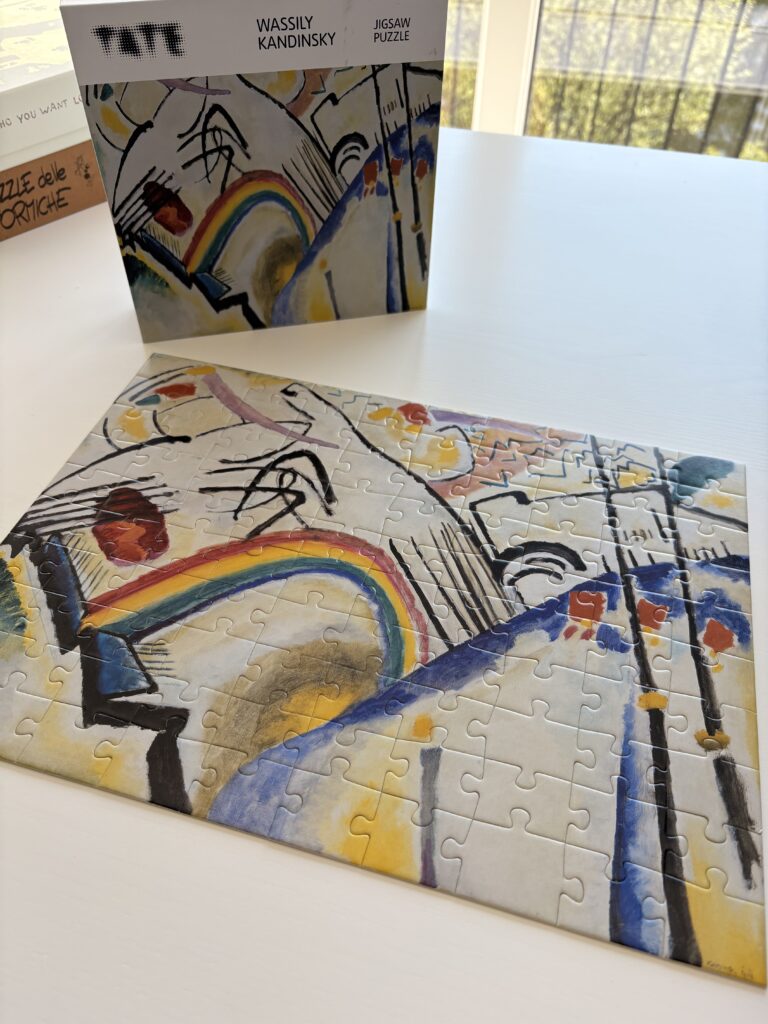
The Canvas Reimagined: Famous Art in Pieces
Puzzles have long relied on classic fine arts to provide satisfying complexity.
Dense oil paintings, impressionist brushwork, and high-contrast illustrations
make excellent source material. When manufacturers select classical art, they
look for specific visual traits that form the core repertoire of replicated art.
For instance, Vincent van Gogh’s The Starry Night is frequently selected
because its thick, swirling impasto lines allow assemblers to track piece direction
by the specific angle of the brushstroke. Gustav Klimt’s The Kiss provides an
intense tactile challenge due to its dense, gold-leaf textures and geometric
mosaic cloaks. For detail-hunters, Hieronymus Bosch’s The Garden of Earthly
Delights is a dream design; its thousands of tiny, chaotic figures mean that
almost every single piece in the box is entirely unique. Katsushika Hokusai’s The
Great Wave off Kanagawatests gradient sorting through the stark contrast
between deep indigo ink, churning sea foam, and blank space. Meanwhile,
Claude Monet’s The Water Lilies series serves as the ultimate test of colour
perception, where a total lack of sharp lines forces the dissectologist to rely
completely on pure hue and subtle shifts in tone.
The Elite Houses of Puzzle Production
To appreciate fine puzzle art, one must look to manufacturers committed to
physical quality and artistic integrity.
Ravensburger: The historic German titan. Famous for its Softclick technology,
ensuring pieces fit together with a satisfying, mathematically perfect snap.
Wentworth Wooden Puzzles: A premium British manufacturer. They produce
laser-cut wooden puzzles featuring intricate “whimsies”—custom pieces carved
into the shapes of birds, buildings, or thematic objects.
Cloudberries: A modern brand tailored for art lovers. They focus on beautiful,
minimalist aesthetics, clean colour gradients, and sustainably sourced matte
cardboard.
Galison: Renowned for collaboration with contemporary illustrators, multi-media
artists, and painters. They frequently add gold foil stamping to their cardboard
pieces.
The New Vanguard: Modern Brands Redefining the Canvas
A fresh wave of boutique puzzle publishers is moving away from the traditional,
gloss-varnished museum look. These companies treat the puzzle box like a
contemporary gallery space, acting as innovators of the puzzle world by
introducing radically different aesthetic and structural concepts.
Among these pioneers, the brand Piecework ditches traditional illustration
entirely in favour of moody, highly stylised, still-life photography. Their finished
boxes resemble high-fashion editorials or interior design magazines, and they
even include a custom music playlist to set the mood for the build. Taking a
narrative approach, the Magic Puzzle Co. blends puzzling with tabletop gaming.
Working alongside independent comic artists, they ensure each puzzle contains
an original story, including a secret envelope that reveals a magical visual twist
to expand the image once completed. For those seeking extreme minimalism,
Areaware is famous for its Gradient series by designer Bryce Wilner. This design
features no lines, icons, or focal points, presenting only a seamless,
mathematical shift from one vibrant hue to another. Finally, Pomegranate acts as
an archival preservationist, partnering directly with underrepresented modern
artists, mid-century graphic designers, and global folk art museums to bring rare
collections to the table.
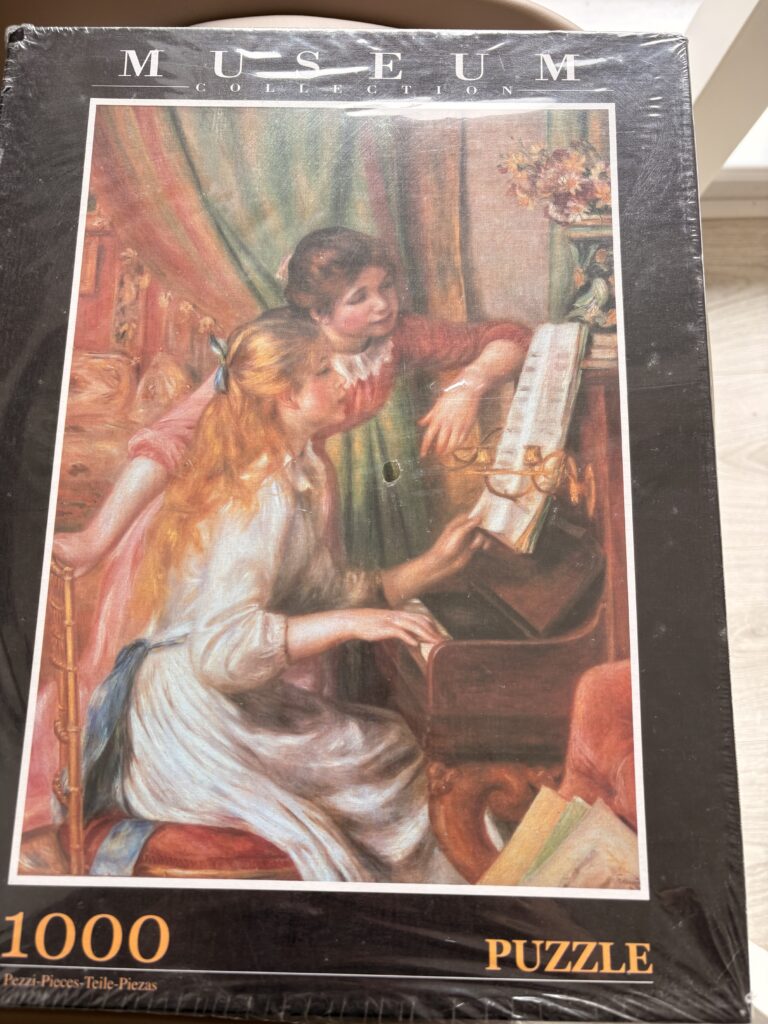
The Counterfeit Canvas: The Case Against AI Illustration
The puzzle world currently faces a major threat from mass-produced, generative
Artificial Intelligence (AI) imagery. While AI puzzles are cheap to generate, a
direct comparison between human artistry and generative AI reveals why these
products offer a deeply frustrating experience for dissectologists.
Human illustrators design with clear intent. Every shadow, texture change, and
focal line is placed deliberately, providing vital clues for the assembler. AI
images look acceptable at a distance but break down under close inspection.
When magnified on a tiny piece, an AI pattern turns into meaningless visual
noise. Staircases lead nowhere, fabrics randomly merge into human skin, light
sources contradict one another, and repeating textures lack structural logic.
Buying AI puzzles supports the theft of human art styles and yields a frustrating,
unsatisfying build. True dissectologists look for boxes that clearly credit human
illustrators and painters.
Artist Spotlight: Elspeth McLean and the Art of the Dot
While historic brands rely on dead masters like Van Gogh, modern companies
look to living creators to challenge today’s dissectologists. Australian artist
Elspeth McLean has become a favourite creator in the puzzle world due to her
highly distinct profile. Her artistic style consists of hypnotic, vibrant mandalas
made of thousands of individual acrylic dots. Her core purpose is to create a
joyful, meditative experience using bright, high-contrast colour theory.
This technique translates into exceptional puzzle appeal. Her work is perfect for
sorting by shade, as each individual piece contains a distinct pattern of raised
dots that guides the player’s hand. McLean creates her art by carefully placing
individual drops of thick paint. This technique results in brilliant, clean patterns
that make excellent puzzle pieces. When working on her puzzles, players cannot
rely on simple edge lines. Instead, they must focus entirely on subtle shifts in
tone and the physical size of the dots. Her success shows that puzzle fans do
not just want a tough challenge; they want a joyful, visual experience that
celebrates real, hand-painted human effort.
Final Assembly
When we snap the final piece into a completed puzzle, we achieve more than
just a neat picture. We complete a journey of close looking that honours human
creativity. In an age of fast media and fake, computer-generated images, the
humble jigsaw puzzle stands as a firm defender of real craftsmanship. It reminds
us that great art is not meant to be scrolled past in a fraction of a second. It is
meant to be held, studied, and slowly built back together, piece by piece.
*A dissectologist is a person who enjoys assembling jigsaw puzzles.
The term is rooted in the 18th-century origins of the hobby. When British cartographer John
Spilsbury invented the very first puzzle in the 1760s, he did so by cutting up wooden maps to teach
geography. Because these early creations were officially called “dissected maps,”those who put
them back together became known as dissectologists.
Today, the title is used proudly by puzzle hobbyists, collectors, and competitive speed-puzzlers
worldwide to describe their passion for the craft.